


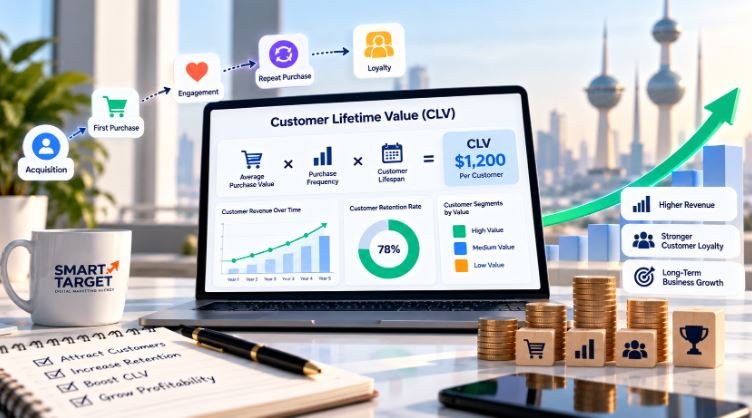

Customer Lifetime Value (CLV) is one of the most important metrics for businesses seeking sustainable growth. While attracting new customers is essential, long-term profitability often depends on how much value customers generate throughout their relationship with a company.
Many businesses focus heavily on advertising costs, website traffic, leads, and first-time purchases. However, these metrics provide only part of the picture. A customer who makes one purchase may contribute less value than someone who returns regularly, recommends the business, and continues purchasing over several years.
Understanding Customer Lifetime Value helps companies evaluate customer relationships, improve retention strategies, allocate marketing budgets, and make more informed decisions about growth.
At Smart Target, customer value can be considered within a broader Digital Marketing & Social Media strategy that connects customer acquisition with engagement, retention, and measurable business outcomes.
What Is Customer Lifetime Value (CLV)?
Customer Lifetime Value is an estimate of the total economic value a customer generates during their relationship with a business.
Depending on the measurement approach, CLV may be calculated using revenue or, more usefully for profitability decisions, contribution margin after relevant costs.
For example, a customer who purchases once for $100 has a different lifetime value from a customer who spends $100 every month for several years.
This distinction is important because businesses do not necessarily need more customers to increase revenue. Sometimes, improving the experience and retention of existing customers can create substantial growth opportunities.
CLV helps businesses understand the long-term financial importance of customer relationships rather than focusing exclusively on individual transactions.
Why Is Customer Lifetime Value Important?
Customer Lifetime Value connects marketing decisions with long-term business performance.
Without understanding CLV, companies may underestimate the value of retaining customers or spend too much acquiring customers who generate limited returns.
Measuring CLV can help businesses:
- Identify valuable customer segments.
- Evaluate acquisition spending more effectively.
- Improve customer retention strategies.
- Understand repeat purchasing behaviour.
- Develop more relevant marketing campaigns.
- Support long-term revenue forecasting.
- Allocate resources towards profitable customer relationships.
However, CLV is an estimate rather than a guaranteed future outcome. Its accuracy depends on reliable customer data and realistic assumptions about future purchasing behaviour.
How to Calculate Customer Lifetime Value
A simplified revenue-based CLV formula is:
Customer Lifetime Value = Average Purchase Value × Purchase Frequency × Average Customer Lifespan
For example, suppose a customer spends an average of $50 per purchase, makes four purchases per year, and remains a customer for five years.
The calculation would be:
CLV = $50 × 4 × 5 = $1,000
The estimated lifetime revenue generated by this customer is $1,000.
However, revenue does not equal profit.
If the business wants to evaluate acquisition profitability, it should consider product margins, service delivery costs, and other relevant expenses.
A simplified contribution-based approach is:
CLV = Average Annual Customer Revenue × Contribution Margin × Customer Lifespan
This version provides a more useful estimate of the financial contribution generated by a customer relationship, although more advanced models may also account for retention probabilities and the time value of money.
The Key Components of Customer Lifetime Value
Several factors influence how much value a customer generates over time.
Average Purchase Value
Average purchase value measures the amount customers typically spend per transaction.
It can be calculated by dividing total revenue by the number of purchases during a defined period.
Increasing average purchase value may improve CLV, provided that margins and customer satisfaction remain healthy.
Purchase Frequency
Purchase frequency measures how often customers buy from a business.
A customer purchasing monthly may generate significantly more revenue than someone purchasing once a year.
Customer Lifespan
Customer lifespan estimates how long customers continue purchasing from or maintaining a commercial relationship with a business.
Longer relationships can increase lifetime value, particularly when customers make repeat purchases.
Customer Retention Rate
Retention rate measures the proportion of customers who remain active over a specific period.
Higher retention can support stronger CLV, although the relationship depends on spending patterns and profitability.
Profit Margin
Revenue-based CLV can exaggerate the economic value of customers when fulfilment, service, or product costs are high.
Contribution margin provides a more realistic foundation for profitability-focused decisions.
Customer Lifetime Value vs Customer Acquisition Cost
Customer Lifetime Value and Customer Acquisition Cost are closely connected, but they measure different aspects of business performance.
Customer Acquisition Cost (CAC) measures how much a company spends to acquire a new customer.
Customer Lifetime Value (CLV) estimates the value generated by that customer throughout the relationship.
Consider a business that spends $100 to acquire a customer who generates $600 in lifetime revenue.
At first glance, the relationship appears attractive.
However, if the business has low profit margins or high service costs, the actual financial return may be much smaller.
For this reason, comparing contribution-based CLV with fully loaded acquisition costs provides a more meaningful assessment than comparing revenue with advertising spend alone.
What Is a Good CLV-to-CAC Ratio?
A frequently mentioned benchmark is a CLV-to-CAC ratio of 3:1.
This means the estimated lifetime value of a customer is three times the cost of acquiring that customer.
However, the appropriate ratio varies according to business model, profit margins, customer retention, cash flow, and growth objectives.
A subscription business with predictable recurring revenue may evaluate this relationship differently from a retailer with seasonal purchases.
Businesses should therefore establish their own targets using reliable financial and customer data rather than treating a general benchmark as a universal rule.
How Customer Lifetime Value Supports Marketing Strategy
CLV helps businesses evaluate marketing performance beyond the initial conversion.
For example, two campaigns may generate the same number of new customers at similar acquisition costs.
However, customers acquired through the first campaign may make repeat purchases, while those from the second campaign may never return.
If the business measures only initial conversions, both campaigns could appear equally successful.
Analysing long-term customer value can reveal important differences between the customer segments and channels involved.
A professional Media Buying & Paid Advertising strategy can use these insights to support better audience targeting, budget allocation, and campaign evaluation.
Customer Lifetime Value and Customer Retention
Customer retention is one of the most important factors influencing CLV.
When customers continue purchasing, businesses have more opportunities to generate revenue without repeatedly paying the full cost of acquiring a new customer.
However, retention should not be pursued at any cost.
Expensive discounts, excessive incentives, or costly service arrangements can reduce profitability even when they increase repeat purchasing.
The objective is to develop customer relationships that provide genuine value to both the customer and the business.
Strong retention strategies may include reliable service, relevant communication, convenient purchasing experiences, and consistent product quality.
How to Increase Customer Lifetime Value
Improving CLV requires understanding what motivates customers to return and what prevents them from continuing their relationship with a brand.
1. Improve the Customer Experience
A positive customer experience can encourage repeat purchases and long-term loyalty.
Businesses should review the complete customer journey, including initial enquiries, purchasing, delivery, support, and post-purchase communication.
Slow responses, unclear information, and complicated processes can discourage customers from returning.
2. Strengthen Customer Relationship Management
Customer relationship management systems can help businesses organise customer information, monitor interactions, and identify opportunities for relevant follow-up.
Effective CRM processes may support better communication, more personalised service, and improved retention.
Integrating customer service with a structured Call Center & CRM approach can help businesses manage relationships more consistently.
3. Use Personalised Marketing
Customers do not all have the same interests, needs, or purchasing patterns.
Segmenting audiences according to relevant behaviour can help businesses deliver more useful messages.
For example, a returning customer may respond better to product recommendations based on previous purchases than to a generic introductory campaign.
Personalisation should rely on appropriate data practices and avoid unnecessary or intrusive targeting.
4. Create Valuable Content
Useful content can support customer relationships after the initial purchase.
Educational guides, product tutorials, service tips, and practical updates may help customers gain more value from what they have purchased.
A strategic Content Creation approach can therefore support both customer acquisition and retention.
5. Introduce Relevant Loyalty Programmes
Loyalty programmes can encourage repeat purchasing when the rewards are meaningful and financially sustainable.
However, a programme should not be judged only by participation rates.
Businesses should assess whether it generates additional profitable purchasing behaviour rather than simply rewarding transactions that would have happened anyway.
6. Improve Cross-Selling and Upselling
Cross-selling introduces customers to complementary products or services.
Upselling encourages customers to choose a more suitable higher-value option.
Both approaches can increase customer value when recommendations genuinely match customer needs.
Aggressive selling or irrelevant offers may damage trust and reduce long-term retention.
7. Optimise the Website Experience
A confusing or unreliable website can discourage customers from making repeat purchases.
Fast loading times, mobile-friendly navigation, clear product information, and convenient contact options can improve the overall experience.
Professional Website Development can help businesses create digital experiences that support both first-time conversions and ongoing customer relationships.
The Role of Brand Loyalty in Customer Lifetime Value
Brand loyalty can influence purchasing frequency, retention, and willingness to recommend a business.
Customers who trust a brand may be more likely to return when they need related products or services.
However, loyalty is built through consistent experiences rather than visual identity alone.
Product quality, customer service, transparency, and reliability all contribute to long-term relationships.
A clear Brand Strategy & Identity can support recognition and trust, while the business must consistently deliver on the expectations created by its brand.
How to Segment Customers by Lifetime Value
Not all customers contribute the same value.
Segmenting customers can help businesses understand differences in purchasing behaviour and identify opportunities for improvement.
Common segmentation approaches include:
- High-value customers who purchase frequently or generate strong margins.
- New customers whose future value is still uncertain.
- Occasional customers with potential for increased engagement.
- At-risk customers showing signs of reduced activity.
- Inactive customers who have stopped purchasing.
These groups may require different communication and retention strategies.
However, segmentation should not automatically result in ignoring lower-value customers. Some may have substantial future potential or different service needs.
Customer Lifetime Value for E-commerce Businesses
For e-commerce businesses, CLV is influenced by purchase frequency, average order value, product margins, and repeat purchasing behaviour.
An online store may attract many first-time buyers through advertising but struggle to generate repeat orders.
In this situation, improving post-purchase communication, product recommendations, delivery experience, and customer support may create opportunities to increase lifetime value.
Businesses should also monitor refunds, fulfilment expenses, discounts, and other costs that affect the profitability of repeat purchases.
A high revenue-based CLV does not necessarily mean customers are highly profitable.
Customer Lifetime Value for Service-Based Businesses
Service businesses often develop customer relationships differently from e-commerce stores.
A customer may purchase a service once, return periodically, or maintain an ongoing contract.
For example, a company providing recurring maintenance services may estimate CLV using contract revenue, renewal rates, service costs, and expected customer tenure.
Professional service providers may also consider repeat projects and ongoing client relationships.
The appropriate calculation should reflect the way customers actually generate value within the business.
Customer Lifetime Value for Subscription Businesses
Subscription companies often have recurring revenue models that make retention especially important.
A simplified subscription CLV estimate may use average monthly contribution margin and expected customer lifetime.
For example, if a customer generates $20 in monthly contribution margin and remains subscribed for an estimated 24 months, the simplified CLV would be $480.
More advanced calculations account for changes in retention, subscription upgrades, downgrades, and the timing of future cash flows.
Businesses should avoid assuming that current subscription behaviour will continue indefinitely.
How to Measure Customer Lifetime Value Accurately
Reliable CLV measurement begins with clean customer data.
Businesses should be able to distinguish new customers from returning customers and connect transactions to the correct customer records where appropriate.
Important information may include purchase dates, order values, repeat purchase frequency, refunds, service costs, and customer retention.
Businesses can also use cohort analysis to examine groups of customers acquired during different periods.
This helps identify whether customer value is improving or declining over time.
For companies with complex customer journeys, combining CRM data with marketing analytics may provide a more complete understanding of customer relationships.
Common Mistakes When Calculating CLV
Several mistakes can make Customer Lifetime Value estimates unreliable.
One common error is using total revenue without considering profitability.
Another is assuming that all customers behave identically.
Businesses may also overestimate customer lifespan, ignore churn, or use historical averages without accounting for changes in market conditions.
Other mistakes include treating predicted revenue as guaranteed, comparing inconsistent measurement periods, and using CLV without considering the time required to recover acquisition costs.
CLV should be reviewed regularly as new customer data becomes available.
Customer Lifetime Value and Marketing Attribution
Marketing attribution helps businesses examine how recorded marketing interactions contribute to conversions.
CLV adds another dimension by considering the longer-term value of the customers acquired.
Together, these concepts can help businesses move beyond evaluating campaigns based only on immediate conversions.
For example, one marketing channel may generate inexpensive first-time purchases, while another attracts customers who remain active for longer and generate greater contribution margins.
Understanding these differences can improve strategic decisions.
However, attribution credit does not necessarily prove causal impact. Businesses making major investment decisions may benefit from controlled experiments and other complementary measurement methods.
Why CLV Matters for Businesses in Kuwait
Businesses operating in Kuwait can benefit from understanding the long-term value of their customers, particularly when competing across digital channels.
Retailers, clinics, restaurants, professional service providers, and e-commerce businesses may all experience different purchasing patterns and retention challenges.
A business that focuses only on generating new enquiries may overlook opportunities to increase repeat purchasing or strengthen existing customer relationships.
By monitoring CLV alongside acquisition costs, retention, and profitability, companies can develop a clearer understanding of sustainable growth.
The objective is not simply to attract more customers, but to create relationships that continue generating value over time.
Why Choose Smart Target for Customer Growth Strategy?
At Smart Target, sustainable business growth can be approached through connected marketing activities rather than isolated campaigns.
Customer acquisition, digital engagement, branding, content, website experience, and customer relationship management can all contribute to the customer journey.
Understanding how these activities influence both acquisition and retention helps businesses make more informed marketing decisions.
The process begins with understanding the business model, target audience, customer behaviour, and available performance data.
From there, companies can identify opportunities to improve customer experiences, strengthen communication, and develop more effective long-term marketing strategies.
The objective is to support measurable business outcomes rather than focusing exclusively on short-term campaign activity.
Build Long-Term Growth With Customer Lifetime Value
Sustainable business growth requires more than acquiring new customers.
Businesses also need to understand the value customers generate, how long relationships last, and which activities support profitable retention.
Customer Lifetime Value (CLV) provides a framework for evaluating customer relationships and connecting marketing investments with longer-term financial outcomes.
By combining accurate measurement, customer experience improvements, retention strategies, and responsible acquisition spending, businesses can make more confident growth decisions.
Contact Smart Target to discuss an integrated marketing strategy focused on customer acquisition, retention, and long-term performance.
Understanding Customer Lifetime Value (CLV) can help your business move beyond short-term conversions and build stronger, more profitable customer relationships.


