


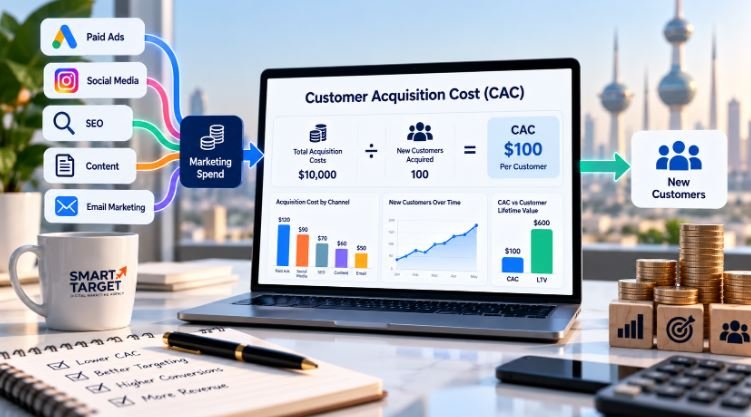

Customer Acquisition Cost (CAC) is one of the most important marketing metrics for businesses that want to grow profitably. Attracting new customers is essential, but understanding how much your business spends to acquire each customer is equally important.
A company might generate hundreds of leads, thousands of website visits, and impressive advertising engagement. However, if the cost of converting those interactions into paying customers is too high, growth may become difficult to sustain.
Understanding Customer Acquisition Cost helps businesses evaluate marketing efficiency, allocate budgets more effectively, and identify opportunities to improve profitability.
At Smart Target, acquisition efficiency can be considered within a broader Digital Marketing & Social Media strategy that connects marketing activities with measurable business outcomes.
What Is Customer Acquisition Cost (CAC)?
Customer Acquisition Cost is the average amount a business spends to acquire one new paying customer during a specific period.
It measures the efficiency of customer acquisition activities by comparing the relevant sales and marketing expenses with the number of new customers acquired.
Unlike metrics such as impressions, clicks, or website visits, CAC focuses on an outcome that directly matters to business growth: acquiring customers.
For example, a business might spend money on advertising, content creation, marketing tools, and sales activities to generate new customers.
By calculating CAC, the company can better understand whether its acquisition efforts are financially sustainable.
However, CAC should not be evaluated in isolation. Its significance depends on factors such as customer lifetime value, gross profit, customer retention, and the time required to recover acquisition costs.
How to Calculate Customer Acquisition Cost (CAC)
The basic CAC formula is straightforward:
Customer Acquisition Cost = Total Customer Acquisition Expenses ÷ Number of New Customers Acquired
Suppose a company spends $10,000 on customer acquisition activities during one month and acquires 100 new paying customers.
The calculation would be:
CAC = $10,000 ÷ 100 = $100
This means the business spent an average of $100 to acquire each new customer during that period.
For an accurate calculation, the company must define which expenses are included and ensure that the customers counted were acquired during the corresponding measurement period.
What Costs Should Be Included in CAC?
A comprehensive Customer Acquisition Cost calculation may include several types of expenses.
Paid Advertising Expenses
Advertising costs can include spending on Google Ads, Meta Ads, and other paid marketing platforms.
These expenses are often among the most visible components of acquisition spending.
Marketing Team Expenses
Salaries, contractor fees, and other costs associated with employees working on customer acquisition may also be included.
Content Production
The cost of producing articles, landing pages, videos, graphics, and other marketing assets can contribute to customer acquisition expenses.
Marketing Technology
Businesses may use analytics tools, CRM systems, email marketing software, and other platforms to support acquisition.
Relevant portions of these expenses should be considered when calculating a fully loaded CAC.
Sales Expenses
Depending on the business model, sales team salaries, commissions, and acquisition-related sales expenses may also be included.
The key is consistency. Comparing CAC across different periods becomes misleading when the definition of acquisition expenses changes.
What Is the Difference Between CAC and Cost Per Lead?
Customer Acquisition Cost and Cost Per Lead are related metrics, but they measure different outcomes.
Cost Per Lead (CPL) measures the average cost of generating a lead.
Customer Acquisition Cost (CAC) measures the average cost of acquiring a new paying customer.
For example, a company might spend $2,000 to generate 100 leads.
Its CPL would be $20.
If only 10 of those leads become paying customers, the advertising-only acquisition cost would be $200 per customer.
The fully loaded CAC could be higher once relevant marketing and sales expenses are included.
This distinction is particularly important for businesses that generate enquiries through forms, phone calls, or messaging platforms.
A low CPL does not necessarily mean customer acquisition is profitable.
Customer Acquisition Cost (CAC) vs Customer Lifetime Value
Customer Lifetime Value (CLV or LTV) estimates the economic value a customer generates over the course of their relationship with a business.
While CAC focuses on the cost of acquiring customers, LTV focuses on their longer-term value.
Understanding both metrics can help businesses assess whether their acquisition spending is sustainable.
For example, consider two businesses with a CAC of $100.
The first generates only $80 in total customer revenue, while the second generates $600 over the customer relationship.
Despite having identical acquisition costs, their economics are very different.
However, revenue-based LTV should not be confused with profit. Businesses should account for gross margins and other relevant costs when assessing acquisition profitability.
What Is a Good CAC-to-LTV Ratio?
A commonly referenced benchmark is an LTV-to-CAC ratio of 3:1.
Under this guideline, a customer generates approximately three times their acquisition cost in lifetime value.
However, this ratio is not a universal standard.
The appropriate relationship depends on the industry, business model, gross margins, customer retention, cash flow, and the methodology used to calculate LTV.
For example, subscription businesses, professional service providers, and e-commerce stores can have very different acquisition economics.
Instead of relying exclusively on a generic benchmark, businesses should establish targets based on their own financial performance.
Why Customer Acquisition Cost (CAC) Matters for Marketing Strategy
CAC connects marketing performance with business economics.
A campaign may produce impressive engagement or a large number of leads, but those results do not necessarily indicate profitable growth.
Monitoring Customer Acquisition Cost helps businesses determine whether their acquisition activities generate customers at a financially reasonable cost.
It can also support decisions about which channels deserve additional investment.
A professional Media Buying & Paid Advertising strategy should therefore consider customer quality, conversion rates, and acquisition economics rather than focusing exclusively on clicks or platform-reported leads.
What Factors Affect Customer Acquisition Cost (CAC)?
Several factors can influence how much a business spends to acquire new customers.
Industry Competition
Highly competitive markets can increase advertising costs, particularly when many businesses target similar audiences and keywords.
Conversion Rate
A website that converts a higher proportion of qualified visitors into customers may achieve a lower acquisition cost, assuming other factors remain consistent.
Audience Targeting
Poor targeting can generate traffic and leads from people who are unlikely to purchase.
Brand Awareness
Customers who already recognise and trust a brand may require fewer interactions before making a purchasing decision.
Sales Process Efficiency
Slow response times, weak lead qualification, and complicated sales processes can increase acquisition costs.
Customer Journey Complexity
Products and services requiring extensive research or multiple decision-makers may involve longer and more expensive acquisition journeys.
Understanding these factors helps businesses identify where improvements can have the greatest impact.
How to Reduce Customer Acquisition Cost (CAC)
Reducing CAC does not simply mean cutting the advertising budget.
The objective is to improve the efficiency of acquiring valuable customers without sacrificing lead quality, customer experience, or long-term profitability.
1. Improve Audience Targeting
Start by identifying the customer segments most likely to benefit from your products or services.
Analyse existing customer data, purchasing behaviour, and campaign performance to refine targeting.
Avoid spending heavily on broad audiences when more relevant segments are available.
2. Optimise Your Website for Conversions
A website should make it easy for visitors to understand your offering and take the next step.
Slow loading times, confusing navigation, unclear calls to action, and complicated forms can reduce conversion rates.
Investing in professional Website Development can support better usability and create a smoother path from initial interest to enquiry or purchase.
Even modest conversion-rate improvements can reduce acquisition costs when traffic and spending remain relatively stable.
3. Invest in Search Engine Optimisation
Paid advertising can generate traffic quickly, but businesses may also benefit from building sustainable organic search visibility.
A well-planned Search Engine Optimization strategy can help businesses attract relevant search traffic without paying for every organic click.
SEO still involves investment in content, technical improvements, and ongoing optimisation.
Therefore, organic customers should not automatically be treated as free acquisitions.
Over time, however, SEO may become an important component of an efficient customer acquisition strategy.
4. Create Content That Addresses Customer Needs
Relevant content can help attract potential customers, answer their questions, and support purchasing decisions.
Educational articles, comparison guides, case studies, and useful videos can contribute to different stages of the customer journey.
A strategic Content Creation approach focuses on providing useful information that attracts qualified audiences rather than producing content solely for visibility.
5. Improve Lead Qualification
Generating more leads is not always the best way to acquire more customers.
If a significant proportion of enquiries are irrelevant, the sales team may spend time and resources on prospects who are unlikely to convert.
Clear messaging, appropriate targeting, and effective qualification processes can improve lead quality.
6. Test Advertising Creatives and Landing Pages
Different messages, visuals, offers, and landing page structures can influence campaign performance.
Testing variations helps businesses identify which approaches generate better results.
However, tests should be evaluated using meaningful conversion metrics and sufficient data rather than making decisions based on small or unreliable samples.
7. Strengthen Brand Trust
Customer reviews, testimonials, case studies, consistent branding, and transparent information can help reduce uncertainty during the purchasing process.
A stronger brand does not guarantee a lower CAC, but it can support customer confidence and improve conversion opportunities.
How Marketing Attribution Helps Explain CAC
Customer journeys often involve several marketing interactions.
A customer may first discover a business through social media, later visit its website through organic search, and finally convert after clicking a paid advertisement.
If the company attributes the entire conversion to the final interaction, it may misunderstand the contribution of earlier marketing activities.
Marketing attribution helps businesses examine how recorded touchpoints contribute to conversions.
However, attribution models distribute conversion credit rather than proving that a channel caused an additional sale.
For major budget decisions, attribution can be complemented by controlled experiments and other measurement approaches.
A more complete measurement strategy helps businesses interpret channel-level acquisition costs with greater care.
How to Measure CAC Across Different Marketing Channels
Businesses often want to compare customer acquisition costs across channels such as paid search, social media advertising, organic search, email marketing, and referrals.
This comparison can be useful, but it requires consistent definitions.
Some channels influence customer discovery, while others are more closely associated with final conversions.
Shared expenses, overlapping customer journeys, and different attribution methods can make channel-level CAC difficult to calculate precisely.
Businesses should therefore document their measurement assumptions and avoid treating every reported channel CAC as a directly comparable measure of incremental performance.
Customer Acquisition Cost (CAC) for E-commerce Businesses
E-commerce businesses often acquire customers through paid advertising, organic search, social media, email, and referral programmes.
For these companies, CAC should be evaluated alongside average order value, gross margin, repeat purchase rate, and customer lifetime value.
A customer acquired at a relatively high initial cost may still become profitable if they make repeat purchases with healthy margins.
Conversely, a low CAC does not guarantee profitability when products have limited margins or high fulfilment costs.
E-commerce businesses should also distinguish between acquiring new customers and generating additional purchases from existing customers.
Customer Acquisition Cost (CAC) for Service-Based Businesses
Service providers often have longer sales cycles and more complex conversion processes than straightforward online purchases.
A potential customer may submit an enquiry, speak with a representative, request a proposal, and compare several providers before making a decision.
For these businesses, measuring only the cost of generating an enquiry can be misleading.
A more meaningful approach connects marketing activity with qualified leads, sales opportunities, and actual customer acquisition.
Integrating CRM data with marketing reports can help businesses understand which activities contribute to valuable customers.
Common Mistakes When Calculating CAC
Businesses should avoid several common measurement errors.
One mistake is calculating CAC using advertising spend alone while describing the result as a fully loaded acquisition cost.
Another is counting leads instead of paying customers.
Companies may also compare acquisition costs across different periods without accounting for seasonality or changes in the sales cycle.
Other mistakes include combining new and returning customers, ignoring acquisition-related sales expenses, and evaluating CAC without considering customer value.
Consistent definitions and accurate data are essential for making meaningful comparisons.
How Often Should Businesses Review Customer Acquisition Cost (CAC)?
CAC should be reviewed regularly, but the appropriate frequency depends on the business model and sales cycle.
E-commerce businesses with frequent transactions may benefit from weekly or monthly monitoring.
Businesses with longer sales cycles may need to examine quarterly trends or use cohort-based reporting to account for the delay between marketing spending and customer acquisition.
It is also important to avoid reacting too quickly to short-term fluctuations.
A sudden increase in CAC does not automatically mean a campaign has failed. The change may reflect seasonality, changes in customer mix, tracking issues, or delayed conversions.
Customer Acquisition Cost in Kuwait
Businesses operating in Kuwait may use several channels to acquire customers, including Google Search, social media platforms, paid advertising, websites, and direct enquiries.
For retailers, clinics, professional service providers, and e-commerce companies, understanding acquisition economics can support more effective budget planning.
A business may generate a large volume of social media enquiries but discover that search traffic produces fewer, more qualified leads.
Another company may find that brand recognition and repeat customer referrals significantly influence its acquisition performance.
The most useful approach is to connect marketing data with actual customer outcomes rather than relying on engagement metrics alone.
Why Smart Target for Customer Acquisition Strategy?
At Smart Target, customer acquisition can be approached as part of an integrated marketing strategy that connects audience targeting, advertising, search visibility, content, website experience, and performance measurement.
Understanding acquisition costs requires looking beyond individual campaigns to examine how marketing activities work together.
The process begins with understanding the business model, target audience, acquisition channels, conversion journey, and available performance data.
From there, businesses can identify opportunities to improve targeting, strengthen conversion pathways, and establish more meaningful performance indicators.
The objective is not simply to generate more traffic or leads. It is to support customer acquisition that aligns with sustainable business growth.
Build a More Profitable Customer Acquisition Strategy
Acquiring customers is essential for growth, but acquiring them efficiently is what helps make growth sustainable.
Customer Acquisition Cost (CAC) provides a valuable way to understand how much your business invests in winning new customers and whether those investments support its financial objectives.
By combining accurate measurement, effective targeting, conversion optimisation, and a clear understanding of customer lifetime value, businesses can make better marketing decisions.
Contact Smart Target to discuss a data-informed approach to customer acquisition, digital marketing, and performance optimisation.
Understanding Customer Acquisition Cost (CAC) is the first step towards building a marketing strategy focused not just on acquiring more customers, but on acquiring the right customers at a sustainable cost.


